How to Size a Generator for Your Food Truck — and Why Two Beats One
Published July 25, 2026 by EZ Food Trucks
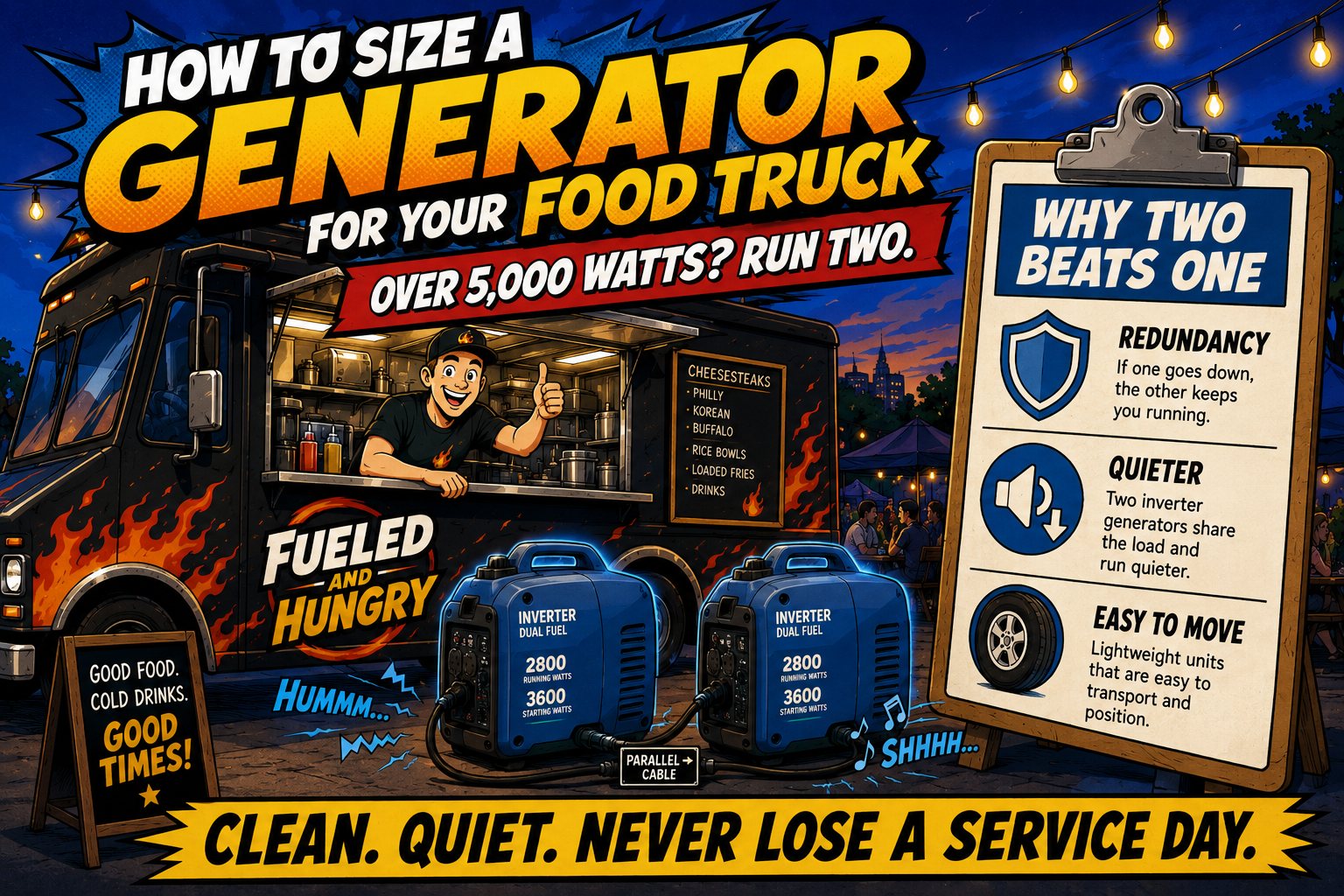
Your generator is the heartbeat of your truck. When it runs, you make money. When it dies, service stops — the fridge warms up, the POS goes down, and the line walks away. So sizing it right isn't a small decision. It might be the most important equipment choice you make.
Here's how to figure out exactly how much power you need, and why — once you get past a certain size — two smaller generators beat one big one every time.
Step 1: Know Your Two Numbers — Running Watts and Starting Watts
Every piece of electric equipment on your truck has two numbers:
- Running watts — the power it uses while it's running normally.
- Starting watts — the quick burst of extra power it needs the moment it kicks on.
For simple things like lights or a warming lamp, the two numbers are the same. But anything with a motor or a compressor — refrigerators, freezers, A/C units, exhaust fans — needs a big surge to start. A fridge that runs on 800 watts might demand 2,000 or more for the first second or two when the compressor kicks in.
This is where most new owners get burned. They add up the running watts, buy a generator that "should" be big enough, and then the whole truck browns out every time the freezer compressor starts during a rush.
Step 2: Make Your Power List
Grab a notepad and walk through your truck. Every electric item gets written down with both numbers — running watts and starting watts. You'll find them on the data plate or sticker on each unit, or in the manual.
A typical list looks something like this:
- Refrigerator
- Freezer
- Exhaust hood fan
- Lights
- POS system and card reader
- Water heater or warmers
- Fans or A/C
- Phone chargers, speakers, anything else you plug in
Now do the math:
- Add up the running watts of everything that could be on at the same time. Be honest — during a rush, it's usually everything.
- Add the single largest starting-watts surge on top. (Compressors don't all start at the same instant, so you plan for the biggest one.)
- Add about 20% headroom. Generators shouldn't live at full throttle — running one at its limit all day shortens its life, burns more fuel, and leaves you nothing in reserve.
That final number is your target. For most trucks running fridges, freezers, fans, and lights on electric — with propane doing the cooking — it lands somewhere between 3,000 and 7,000 watts. If you're cooking on electric equipment too, it climbs fast from there.
Want to skip the pencil math? Use the calculator below — it runs the same steps for you. And if you'd rather walk your truck with a clipboard, download our free printable Power Tracker worksheet and fill it in as you go.
Step 3: Buy an Inverter Generator — Not a Construction-Site Screamer
Not all generators are equal. The cheap open-frame units you see at the hardware store are built for job sites, and they have two problems for food trucks:
- They're loud. 75 to 80 decibels — about like standing next to a running lawn mower for your entire service. Your customers hear it. The event organizer hears it. Some events and breweries will flat-out turn you away over it.
- They make "dirty" power. The voltage swings up and down, which is hard on the sensitive electronics in your POS, card readers, and modern fridge controllers.
An inverter generator fixes both. It produces clean, stable power that's safe for electronics, it sips fuel by throttling down when demand drops, and it runs at 52 to 60 decibels — closer to a normal conversation than a lawn mower.
💡 Power Tip: QUIET IS A BOOKING ADVANTAGE. Event organizers remember the truck they didn't have to hear. More and more festivals and private events now require quiet generators — a whisper-quiet setup doesn't just keep customers happy, it gets you booked places loud trucks can't go.
The Big One: If You Need More Than 5,000 Watts, Run Two Generators — Not One
Here's my strongest recommendation in this whole post. Once your power target passes about 5,000 watts, don't buy one giant generator. Buy two mid-size inverter generators and run them in parallel.
"Parallel" just means connecting two generators with a parallel kit — a simple cable set the manufacturer sells — so they combine their power into one output. Two 4,500-watt units become roughly 9,000 watts of capacity, working together automatically.
Why two beats one:
1. Redundancy — this is the big one. If your single big generator dies mid-service, you're done. Lights off, fridges warming, line gone, day over. If one of your two paralleled units dies, you shut down a few non-essentials and keep serving on the other one. One generator failing is an inconvenience. It's not a lost day of revenue anymore.
2. It's quieter. Two mid-size inverter units humming together are dramatically quieter than one big open-frame unit roaring at full load. Your setup stays conversation-friendly.
3. It's easier to move. A single 9,000-watt-class generator can weigh 250 pounds or more — a two-person lift, minimum, and miserable to load. A mid-size inverter unit weighs around 100 pounds with built-in wheels and a pull handle. One person can roll it like a suitcase.
4. It matches your load. On a slow day, run one unit and save fuel. Big festival day, run both. You're not paying to run a monster at half throttle.
💡 Power Tip: MY PICK IS THE WESTINGHOUSE iGEN SERIES. These are the generators I recommend to every truck owner who asks. They're quiet, fuel-efficient, parallel-ready, and they've proven reliable on trucks working real schedules. Two iGen units with the parallel kit gives you 8,000–9,000 watts of clean, quiet power, real redundancy, and nothing on the truck you can't move by yourself.
A Few Rules That Keep You Cooking
- Never size to 100%. Keep your everyday load at 75–80% of capacity, tops. Your generator lives longer and you have room for surprises.
- Exhaust points away from the truck and away from people. Carbon monoxide is invisible and deadly serious. Keep the generator outside, in open air, pointed away from your service window and any tent walls.
- Do the maintenance. Oil changes and clean air filters are the difference between a generator that lasts 3 years and one that lasts 10. A dead generator on event day almost always sent a warning first.
- Carry more fuel than the math says. Running out of gas mid-rush is 100% preventable and 100% embarrassing.
The Bottom Line
- List every electric item with its running and starting watts. Total the running watts, add the biggest surge, add 20%.
- Buy inverter generators — quiet and safe for your electronics.
- Over 5,000 watts of need? Run two in parallel. You get redundancy, less noise, and units one person can actually move.
- My pick: the Westinghouse iGen series with the parallel kit.
Power isn't the glamorous part of the business. But the trucks that never lose a service day all have one thing in common: they treated the generator like the heartbeat it is.
Book a food truck for your event · List your food truck free